Wednesday, April 24, 2013

Unit T Big Question #2

How do the graphs of sine and cosine relate to each of the others?

Sin and cos graphs do not relate at all to the tangent and cotangent graphs. They are complete opposites. sine and cosine do not have asymptotes like tangent and cotangent. Tangent and cotangent do not use the sine and cosine graphs as references like the secant and cosecant  do. Sine and cosine's domains are all real numbers while tangent and cotangent's are limited. Tangent and cotangent's ranges are all real numbers while sine and cosine's are limited. Sin and cosines have amplitudes while tangent and cotangent do not. Sine and cosine have periods of 2pi while tangent and cotangent have periods of pi.

Secant and cosecant graphs, however, are directly related to sine and cosine graphs. Secant and cosecant graphs' shapes are based on their corresponding cosine and sine graphs. Secant and csc use sin and cos's amplitudes to plot certain points. Sec and csc use the x-intercepts of sin and cos's to draw out their asymptotes. Without these asymptotes, a sec or csc graph cannot be drawn.

Unit T Big Question #1

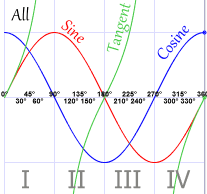
The Unit Circle has four quadrants, each separated by half of pi (Quadrant I: 0 to pi over 2, Quadrant II: pi over 2 to pi, Quadrant III: pi to 3pi over 2, Quadrant IV: 3pi over 2 to 2pi). The trig graphs' x-axis is separated also by these values. The trig graphs' x-axis is just the unit circle values in a linear perspective.
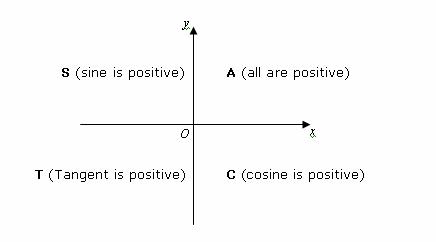
 Whether a trig function is positive or negative in a certain quadrant (ASTC) is determined in the Unit Circle and this dictates how we draw the trig graphs. If the trig function value is positive, we draw it above the x-axis; below if it is negative.

Sin is positive in the first quadrant and the second quadrant; it is negative in the third and the fourth. If one goes counterclockwise, starting from quadrant 1, one will see that this pattern continues after the first rotation which is 2pi. Cosine has a similar pattern that repeats itself after 2pi. Tangent's ASTC pattern is: postive in the 1st, negative in the second, positive in the 3rd and negative in the fourth. This pattern, as you can see, repeats itself after the second quadrant which is represented by pi. Cotangent has the same pattern as tangent.

Sunday, April 14, 2013

Unit S Assessment 4


This problem is about trigonometric equations that we have to solve using the half angle formulas we learned earlier in this unit. By substituting in a trigonometric half-angle formula for a certain expression, we can then use algebra, the unit circle, and the trig identities to simplify the new equation.

Pay special attention to the caution I practiced when I started a new step for every thing I did. I did this so that it would be less likely for me to make a mistake.

Unit S Assessment 2


Although the final answers from the half angle expressions are different than their difference formula counterparts, they are the same value. If you plug in the trig functions in a calculator for 75 degrees, you will get about .966 for sine, about .259 for cosine, and about 3.732 for tangent. When I plug in the expressions carefully and correctly, I get the exact same answers. If you check and get different answers, are you sure your calculator is in degrees and not in radians?

Unit S Assessment 3


This problem is about simplifying trigonometric expressions using power-reducing formulas. For the problem I simplified above, I had to use the sine and cosine power reducing formulas because tangent was irrelevant. 

Pay special attention to the formulas and the way I kept simplifying them. If the formula is off or if you make a mistake simplifying then your final answer can be wrong.

Wednesday, March 27, 2013

Unit R Concept 3 - Student Problem


This problem is about finding the trig function of an inverse trig function. The "type 2" problem I made and solved above comprises of using Unit Circle values to easily find the trig function values inside the parenthesis.

Pay close attention to the fact that I used the 1st quadrant angle for sin v = 0 instead of the 2nd quadrant angle. If I chose the second one then the answer will be different but it would not be necessarily wrong.

Tuesday, March 26, 2013

Unit R Concept 2 - Student Problem


This problem is about using the sum and difference formulas. Only this time it is when values are given for a right triangle.

Pay close attention to the way I drew the triangles with the knowledge of which quadrants they were in. The way you draw the triangles is crucial to finding the desired and unknown trig functions.